
Analysis · Not first-hand reporting
Am I Breaking The Law Riding My EUC / ESKATE / EBIKE / ESCOOTER?
By Scott Bradford · February 28, 2023
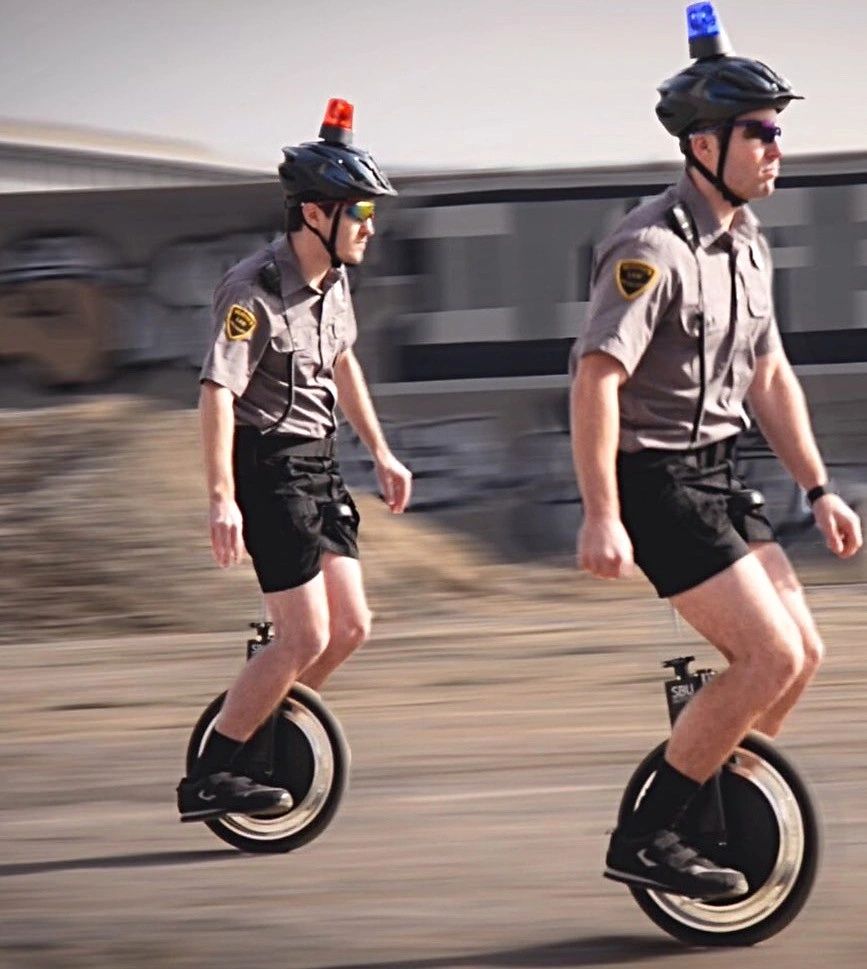
It's an exciting time for the development of Electric personal mobility vehicles! Several new options are now available with advantages over traditional riding methods that weren't possible until recently.
While some vehicles are much like traditional bicycles and thus fall into well-established patterns of use, others are having a tough time with uncertainty. Many new high-end electric unicycles and scooters can achieve speeds over 50mph, and some e-bikes can go even faster!
When does an e-bike become an e-motorcycle requiring a license plate, insurance, and motorcycle endorsement driver's license? Should it really matter if the bike has pedals or pegs? Some jurisdictions will specify a different class if there is an ability to pedal power (at least partially) the bike. What if a foot peg bike does 30mph, but a bike equipped with pedals can do 40mph? Sure it seems obvious that you might not want to be strolling through the park while some high-powered vehicle whips past you at 50+ mph, but at what speed is cruising through a park OK? 40, 30, 20, 10???
Move past E-bikes, and it doesn't become any clearer. Because EUCs (Electric Unicycles) are so new, and laws take so long to come about, most places don't specifically name them, and they are lumped in with other types of similar but not the same vehicles. They're not personal mobility scooters, and they're not bicycles or mopeds. This leaves law enforcement officers giving tickets, not giving tickets, or threatening to ticket because they're not sure if they should. If you were ticketed and faced a $75 fine for riding where you're not supposed to, what would it cost to fight the ticket versus just paying it and moving along? Would you lose a day of work going to court to try and get a ticket reversed with a chance of still having to pay and then missing a day's pay? If you're a big law firm and someone approaches you to defend them in court, with the only potential upside that there's no $75 downside, do you take the case?
The UNCERTAINTY is hurting the adoption of these new vehicle types.
For the consumer, when buying an e-bike, EUC, or e-scooter, would you spend $1500 on your new vehicle if you thought you might not be allowed to ride it? What happens when you make it a part of your commute, get rid of your car, and then find out that no roads permit your vehicle type between you and your place of employment? In the United States, most areas allow what is commonly called an LSV (Low-Speed Vehicle) with a minimum top speed of 20mph but not more than 25mph to operate on roads with a speed limit under 35mph. But that also requires your LSV to have a windshield (with wipers), full lights (brake, turn, and headlamps), and a license plate but no insurance. If I have a 4 wheeled scooter with a seat, do I now need a windshield? Class 1, 2, and 3 e-bikes seem somewhat arbitrary, with some areas defining a max power level of 750 watts, others 1,000 watts, and others describing max speeds or the presence of pedals.
For manufacturers, getting to economies of scale takes large investments, and large investors like to be CERTAIN of what they're getting into. Where will we be permitted to sell our products? Will we be liable for misuse if we don't educate our consumers and if so, what do we tell them? Without getting to large-scale manufacturing, prices for these types of vehicles will remain relatively high. Still, with enough scale, they could get marvelously cheap and accessible to many more people. Having access to affordable personal transportation is empowering. It enhances the quality of life for people who would otherwise choose between hours waiting on public transportation or paying hundreds of dollars a month to maintain the operation of an automobile.
The questions are many:
- Where can I ride?
- How fast am I allowed to go?
- Do I need Insurance or registration?
- How old do I have to be?
- Do I need an operator's license?
- What if I'm wrong, what fines will I face?
- Will my vehicle get impounded if I go into the wrong area?
- What have I not even thought to ask?
What we need is UNITY to create some CERTAINTY.
We could just devise a nice system to fit all these scenarios... What would it look like? Going down to 'first principles' and working our way up from there is what's needed. The dangers of moving vehicles are based on the potential energy of impact, and the potential energy is a function of speed and mass. Automotive laws already consider these factors by different speed limits and different rules for the weight classes of vehicles. So at the bottom of the scale is a walking person, avg 150lbs and 3.5mph, no license needed. Then what's next? Skateboard, then bicycle, then EUC? NO! Just go by weight and speed and use a potential energy mass index. Since we are who we are and people are people, we should remove from the calculation the weight of the person and only use the weight of the vehicle, or substitute a set weight of a person as 150lbs regardless of who is riding. If for example, I created my own E-bike with super long range that weighed 1,500lbs but only went 20mph, it should be considered more dangerous than a 75lb ebike that can do 40mph. We need to look at Kinetic Energy.
according to Wikipedia, Kenetic Energy is:
The kinetic energy of an object is the energy that it possesses due to its motion.[1] It is defined as the work needed to accelerate a body of a given mass from rest to its stated velocity. Having gained this energy during its acceleration, the body maintains this kinetic energy unless its speed changes. ***The same amount of work is done by the body when decelerating from its current speed to a state of rest. ***
So this means that when you're moving, how much you weigh and how fast you're going is HOW HARD YOU WILL HIT SOMETHING if there is an accident.
Ultimately when you calculate this manner, you will end up with a number in joules. Try out this nifty online knetic energy calculator
Let's say I acquired one of those awesomely cool Sur-Ron electric bicycles weighing 150lbs, and I assume the 150lb rider, I can calculate that 300lbs, going 30mph, is 12.23 kJ (Kilo Joules). That same bike going 20mph is 5.43 kJ, or going 50mph jumps up to 33.99 kJ. The way that Kinetic Energy works, 1/2 the mass times the velocity squared means that speed has a perceivably greater effect than mass, but mass should not be discounted in our new rational rules scenario.
While law enforcement would have a tough time measuring an engine's power to determine if your motor or controller exceeded 750kw, they already have the equipment to measure speed, and being able to measure weight (mass) would be pretty easy to set up. So working the kinetic energy numbers into a rational rules system seems like a no-brainer! say I swapped my 150lb ebike for a 75lb EUC, my kinetic energy at 50mph now drops to about 25.72kJ, and drops down to only 9.25kJ at 30mph.
So we don't all need to run around with slide rules, we can come up with a speed limit that also has a max weight class associated with it. Say we have weight classes 1,2, 3, 4, and 5 for 25lbs, 50lbs, 75lbs, 100lbs, and 150lbs (I know this should probably be done in metric to become universal around the world, I'm just throwing some rather random numbers around for the moment) Perhaps sidewalks are 5mph and only permit class 1 and 2. Bike paths 20mph and allow classes 1-3, and special PEV lanes up to 50mph permit all classes 1-5? Of course, if you can exceed 50mph, you should be able to keep up with road traffic like a motorcycle in most urban scenarios.
Insurance companies LOVE certainty! perhaps classes 1 and 2 don't require insurance, but classes 3,4, and 5 could qualify for affordable PEV insurance? I have a motorcycle that only costs me $130 a year to insure. Perhaps PEV insurance could be as cheap as $60 a year (just $5 a month)?
Governments who have previously relied on fuel taxes to help subsidize road construction are now looking at registration costs and considering the WEIGHT of the vehicle combined with the annual mileage as a function of how much wear and tear it will cause to road surfaces. With our new classes, what kind of wear will even a class 5 PEV have compared to a 5,000lb automobile? Very little, justifying very minimal costs to register. When considering the cost of maintaining a road, urban planners may want to suggest MORE PEV lanes to get more value from the investments made.
What if I CAN go fast, but I don't?
We all know that just because you can do something doesn't mean you should. In the automotive world, you won't get a speeding ticket just for owning a fast car, but in the E-bike world, you can be ticketed for riding a faster bike where it's not allowed even if you aren't exceeding any speed limits! This speaks to the arbitrary and outdated rules that need to be updated.
What if we had clearly defined riding modes and a way to signal that we have engaged those modes to remove doubt (and temptation) that we're exceeding the permitted speed? We might try:
Walkway mode = 5mph max signaled by flashing red lighting
Park Mode = 20mph max signaled by flashing yellow lighting
Bike trail Mode = 30mph max flashing white lighting
Street mode over 30mph = like a motorcycle daytime running lights and full signals required (brake, turn signals, and headlight)
Now I could commute across town on my E-bike with traffic at full speed, then dip into a bike trail or park mode for a portion of my journey, and finally, enter a shopping area in walkway mode to creep along to the final destination. How many more people would ride PEVs instead of cars if they had this type of flexibility?
For lack of better ideas, some places have BANNED EUCs and E-Scooters!!!
We can do better!
What do you like about your local riding laws? What would you change if you could?
CEVRA is putting together information resources in hopes of helping everyone come together and advance the use of clean energy vehicles. There's so much to do! Please share your thoughts with us; we NEED YOUR INPUT AND INSIGHTS!
CEVRA is beginning to develop material to help advance Clean Energy Vehicle Recreation. Please <u>follow us</u> on your favorite social media platforms or <u>Subscribe to our weekly newslette</u>r to track our progress. We'd also love any suggestions you have on helping us to advance clean energy vehicle recreation. <u>Drop us a line!</u>
A few interesting articles about different riding laws. Some are a bit dated. Always check with your local authorities to be sure.