
Explainer · Not first-hand reporting
The Current State: How Electrical Inverters Work
By Scott Bradford · November 9, 2023
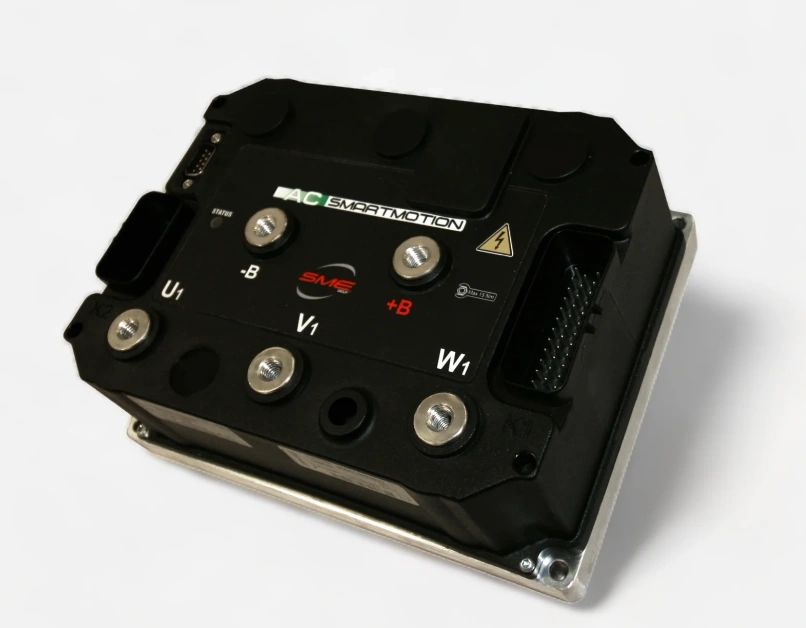
How Electrical Inverters Control Electric Traction Motors in Electric Vehicles
Electrical inverters are essential components of electric vehicles (EVs). They convert direct current (DC) power from the battery pack into alternating current (AC) power, which is required to drive the electric traction motor. The inverter also controls the frequency and voltage of the AC power, which allows for precise control of the motor speed and torque.
How Inverters Work
Inverters typically use a combination of power semiconductor switches, such as insulated-gate bipolar transistors (IGBTs) or silicon carbide (SiC) MOSFETs, to control the flow of current through the motor. The switches are controlled by a microcontroller (MCU), which receives feedback from sensors on the motor and vehicle.
The MCU uses the sensor feedback to calculate the desired current and voltage waveforms for the motor. The inverter then switches the power semiconductor switches to generate the desired waveforms.
Sensor Feedback
The inverter uses a variety of sensor feedback to control the motor. The most common sensors include:
- Motor speed sensor: This sensor measures the rotation speed of the motor shaft.
- Motor torque sensor: This sensor measures the torque produced by the motor.
- Vehicle speed sensor: This sensor measures the speed of the vehicle.
- Accelerator pedal position sensor: This sensor measures the position of the accelerator pedal.
The inverter uses this sensor feedback to calculate the desired current and voltage waveforms for the motor. For example, if the vehicle is accelerating, the inverter will increase the current and voltage waveforms to increase the motor speed and torque.
Adjusting Driving Dynamics
The inverter can be used to adjust the driving dynamics of the vehicle in a number of ways. For example, the inverter can be used to:
- Increase the acceleration: By increasing the current and voltage waveforms, the inverter can increase the motor speed and torque, which results in faster acceleration.
- Improve the handling: The inverter can be used to control the torque distribution between the front and rear wheels, which can improve the vehicle's handling.
- Recover energy during braking: When the vehicle brakes, the motor can be used as a generator to recover energy and recharge the battery.
Inverter Circuitry
Inverters typically use a three-phase bridge converter circuit. The bridge converter circuit uses six power semiconductor switches to generate three-phase AC power from the DC power input.
The inverter also includes a number of other components, such as:
- Gate drivers: These components control the switching of the power semiconductor switches.
- Filters: These components filter out the high-frequency switching noise generated by the power semiconductor switches.
- Cooling system: The inverter requires a cooling system to dissipate the heat generated by the power semiconductor switches.
Different Approaches to Inverter Engineering and Design
There are a number of different approaches to inverter engineering and design. Some of the key factors that influence inverter design include:
- Power rating: The inverter must be able to handle the high power requirements of the electric traction motor.
- Efficiency: The inverter must be as efficient as possible to minimize energy losses.
- Cost: The inverter must be cost-effective to produce.
One of the key trends in inverter design is the use of SiC MOSFETs. SiC MOSFETs have a number of advantages over traditional IGBTs, including higher switching speeds, lower switching losses, and higher thermal performance. This makes SiC MOSFETs well-suited for use in high-power inverters for EVs.
Another trend in inverter design is the use of modular inverters. Modular inverters are made up of a number of smaller inverter modules. This makes it easier to scale the inverter to meet the power requirements of different electric vehicles.
Conclusion
Electrical inverters play a critical role in the performance and efficiency of EVs. By using sensor feedback to control the motor speed and torque, inverters can help EVs to accelerate quickly, handle well, and recover energy during braking.
Inverter engineers are constantly working to develop new inverter designs that are more efficient, cost-effective, and reliable. As inverter technology continues to improve, EVs will become even more attractive to consumers.
MORE INFO:
- Check out this page on SKYWORKS that goes into more detail and provides design tools as well as technical documentation for their product line.
- Legacy EV has a page listing a few aftermarket automotive scale inverters.