
Explainer · Not first-hand reporting
The Current State: Electric Bicycles, Legal On Roads or not?
By Scott Bradford · March 6, 2023
Bicycles, the most pervasive form of personal mobility, have also seen the most advancement in electrification. The abundance of form factors and use case scenarios has started to blur the lines of what is still considered a bicycle. In this edition of The Current State, we examine some of the edge case scenarios and where industries and governments are trying to define what you can ride and where you can ride it.
Most of the consideration for electric bikes is based on using them as a commuter vehicle relative to alternatives such as owning an automobile, using mass transit, ride-sharing, or plain non-electric bicycles. Undoubtedly finding a sensible, cost-effective, and environmentally respectful way to get to work and pay bills is important for almost everyone. Still, at CEVRA, we focus on the fun part, riding for recreation. Nonetheless, we must speak to both functions as electric bike use rules are largely focused on commuting.
A standard set of E-Bike Classifications
To create standards that everyone could agree upon, the People For Bikes organization ( https://www.peopleforbikes.org/ ) has promoted a 3 class e-bike system detailed here:
- A “class 1 electric bicycle” is equipped with a motor that provides assistance only when the rider is pedaling, and that ceases to provide assistance when the bicycle reaches the speed of 20 miles per hour (about 32 km/h).
- A “class 2 electric bicycle” is equipped with a motor that may be used exclusively to propel the bicycle, which is incapable of providing assistance when the bicycle reaches the speed of 20 miles per hour (about 32 km/h).
- A “class 3 electric bicycle” is equipped with a motor that provides assistance only when the rider is pedaling, and that ceases to provide assistance when the bicycle reaches the speed of 28 miles per hour (about 45 km/h) and is equipped with a speedometer.
Further limiting what can be considered a bicycle for all three classes is the maximum power output being limited to 750 watts, roughly equivalent to 1hp. Manufacturers and distributors must apply a class identification label to each electric bicycle. In a study of e-bike rules, various jurisdictions set this level at 1000 watts or 500 watts instead of 750 watts. This is why you will frequently see these three power levels offered by e-bike manufacturers.
With the 3-class system, classes 1 and 2 would be permitted anywhere traditional bikes are permitted as the 20 mph speed is closely matched with speeds traveled by traditional bicycles. Class 3 bicycles are permitted on roads, and anywhere traditional bikes are allowed. Still, they can be restricted from slower-speed areas such as multi-use paths where they are more likely to encounter pedestrians. Class 3 may also be subjected to stricter safety requirements such as minimum age or helmet mandate.
All three classes 1,2, and 3 still qualify as bicycles and thus would not require licensing, registration, or insurance like motorcycles or mopeds.
How is this playing out so far? What is the 'Current State' of e-bike rules in the United States?
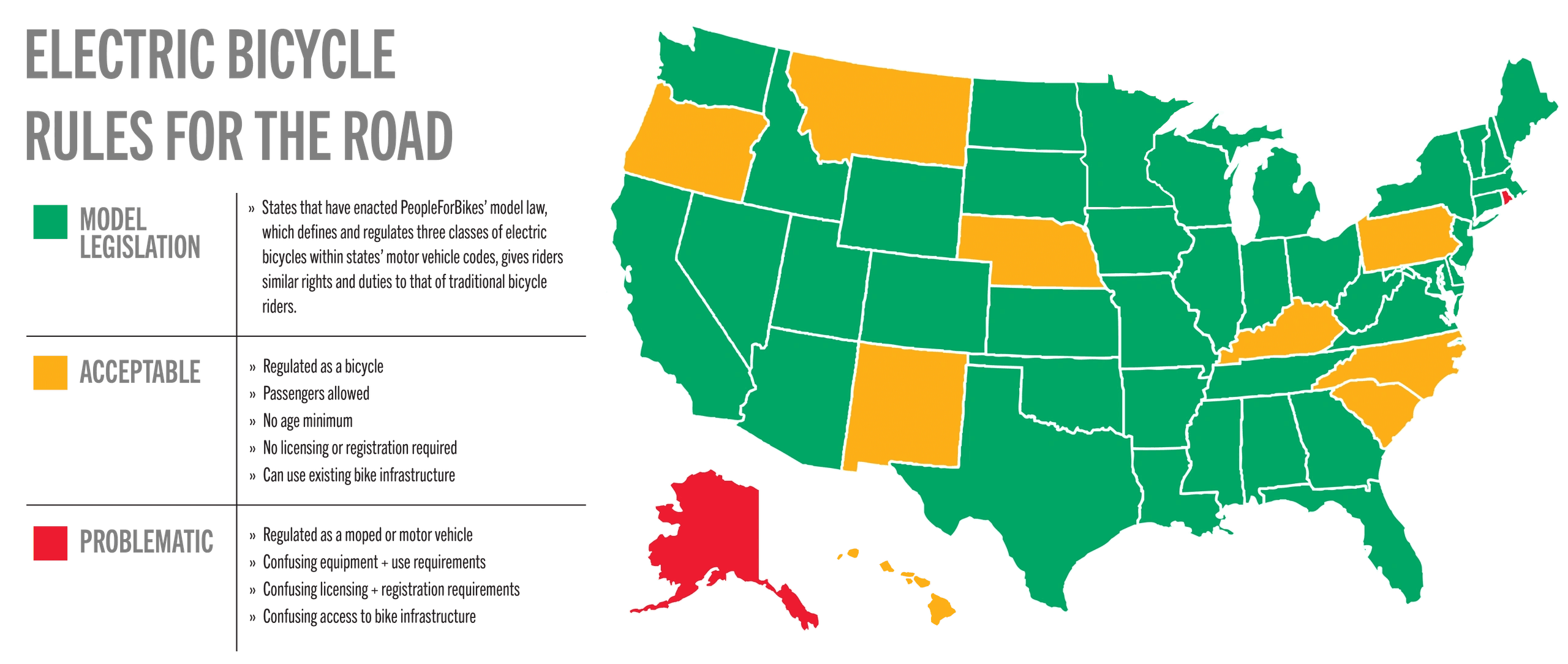
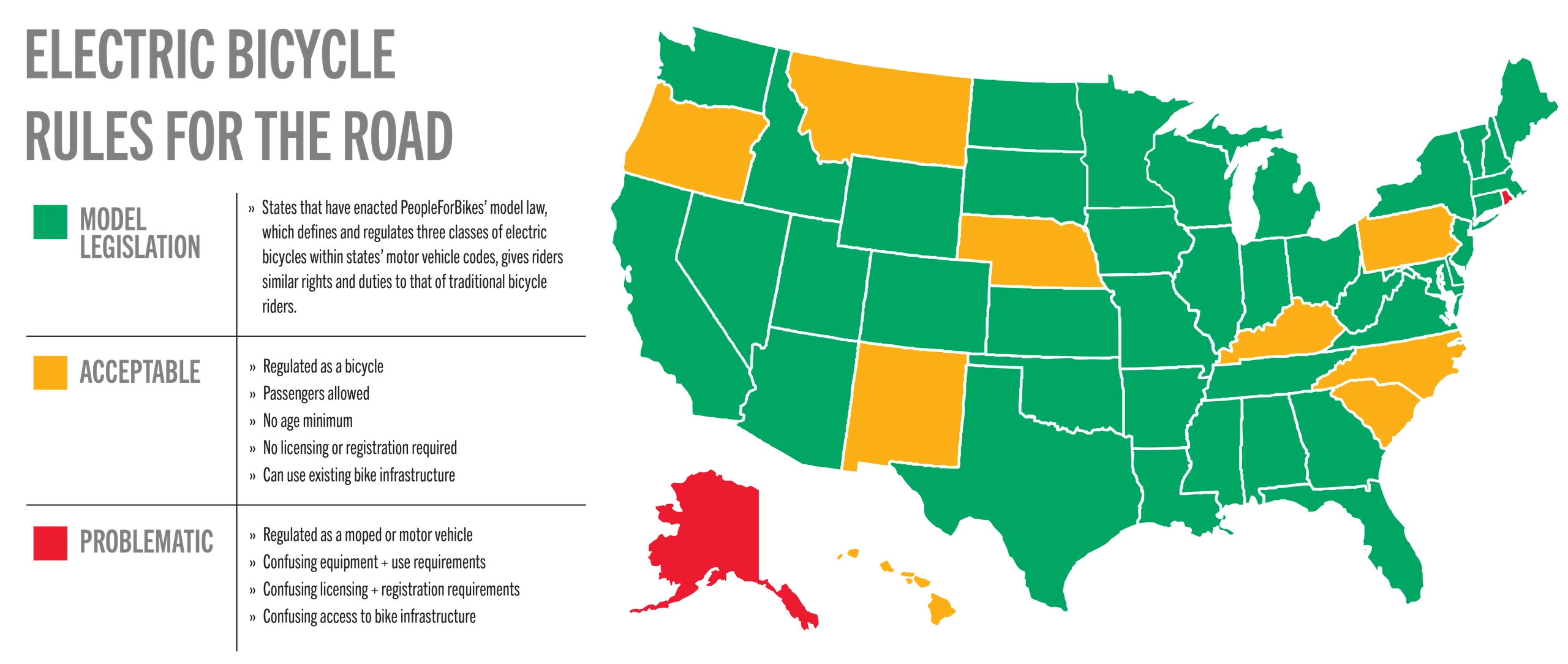
Most states have gotten behind the three-class e-bike system. peopleforbicycles.org takes the same stance we at CEVRA.org do in that consistency, and easily understandable rules help riders, lawmakers, and manufacturers. From their website:
- Electric bicycle laws are different in every state, and can be confusing for riders, retailers, and suppliers. PeopleForBikes is making riding an electric bicycle easy and accessible for all by working to create clear rules on how and where people can ride electric bicycles. With more coherent laws: Local bicycle shops and manufacturers see increased business and their customers will no longer be confused, people who already ride electric bicycles more easily understand where to ride, and new riders who may be discouraged from riding a traditional bicycle due to limited physical fitness, age, disability or convenience have improved transportation alternatives*.
Here's a map from the same page showing how many states have more or less adopted the three-class e-bike system:
To find more specific rules for your state, they also have a page with "one-page PDF guides" of e-bike laws
Does this make E-Bikes a viable option for people commuting?
Whether taking an e-bike to work sounds attractive depends on your alternatives, means, and environment.
If you currently depend on mass transit owning an e-bike might be a very appealing proposition. The thought of leaving directly from home, independent of when the next bus is due on your own schedule, cruising past people waiting around at the bus stop, and saving the cost of a monthly bus pass (currently $65 a month here in Las Vegas) all sound like a good deal.
If you own an automobile, your benefits are more likely around financial savings. Sure there's the fresh air and exercise aspect of riding a bike, but you could roll the windows down and go to the gym. With the price of automobiles continuing to climb the typical commuter needs to spend $300 to $500 a month on a car payment and $100 to $200 a month on insurance, then there's gas and maintenance etc... figure on spending $500 to $1,000 a month (or more if you like a fancy car) on car ownership.
Another consideration would be riding in extreme weather. What if you live in a place with snow on the ground for several months a year? Beyond just riding in cold temperatures, it can be treacherous and slow to ride a bicycle on ice and snow. At the other end of the spectrum, extremely hot temperatures can be very difficult for people, particularly those who may not be in top physical condition. Rain is just wet but the idea of showing up to work soaked and having to deal with drying out or just being damp all day is a concern everywhere on some days, and in some places most days it rains. If a municipality puts enough resources into bike trails as some countries do, then even extreme weather doesn't prohibit riders from getting around as paths are clear and maintained adequately (much like roads get plowed after a snowstorm) While things are better than they used to be, most cities still have an automobile-centric urban layout and priorities. Unfortunately, if you were to keep a car for use on days when riding was difficult, you would lose most (but not all) of the financial benefits of e-biking because you still need to make car payments to own a car and insurance rates to operate a car even if you rarely drive it.
It would be nice if insurance companies could just bill per mile of usage and if your car sat in the driveway all month without moving, you'd avoid having an insurance payment for that month. With this kind of cost reduction and the flexibility to use a car when needed, I'm certain many more people would e-bike than do now. This type of coverage would likely require legislative approval in addition to insurance underwriters willing to try something new; sign me up if they do!
So for commuting, some advancements in urban planning to create more paths for personal mobility and flexibility in automobile insurance would go a long way toward advancing e-bike use for many people.
OK, What About the FUN part?
YES! FUN! Ok. Let me state here that we feel our leisure time is important and that for many who are struggling to get by with low-income fun can often get pushed aside for a few extra hours art work, or time to rest from being at work too much. So yes, we feel there is a place for defenders of recreation because life is more than just going to work and paying bills! The time you enjoy wasting is not wasted time! Please have as much fun as you can manage in your daily life.
So back to e-bikes, this time for fun. What about that 20- and 28mph classification, and the max power limits on what can qualify as an e-bike? Most of the types of people that enjoy riding may also be the type of people who enjoy the rush of riding fast, so is that fast enough? Yes and no.
If you're on a path among others riding, it makes sense to limit the speed to match the environment so that it can be reasonably safe for all parties involved. Just like a car crawling down a 75mph highway at 15mph would pose a serious risk of impact, on a lesser scale so does a person walking at 4mph among cyclists moving along at 20mph. Given that a cyclist can achieve about 20mph without any electric assist this is the threshold chosen for class 1 and 2 e-bikes, and from that perspective it makes sense. Remember that classes 1 and 2 are pedal-assist or not both with max assisted power speeds of 20mph.
Class 3 top speed is 28 mph but requires pedal-assisted power ONLY. This one seems a little strange as it doesn't specify how hard someone has to pedal only that the max power is set to 750 watts and the power assist cuts out at 28mph. So why the pedaling requirement at all? IDK! Perhaps there is a feeling that if you want to go 28mph, you should have to work for it? Perhaps so that the only people who get to cruise at 28mph are the ones who are physically capable of navigating at those speeds?
The pedal requirement is a bit strange and has led to "Pedal Kits" which you can add to your class 3 e-bike in hopes of being more readily accepted as a road or bike path-legal e-bike. These kits don't limit the top speed of your e-bike, so in reality, they don't change what class it is unless you are already topped out at 28mph, and even then this isn't a manufacturer's designation as the rules would specify. For law enforcement, if they pull over an e-bike user for riding where they're not supposed to, other than a sticker how would they determine what class a bike falls under? Can you imagine such a system being applied to cars where law enforcement needed to keep a database of how fast a car COULD GO to determine if it should be permitted to drive on certain roads?
Say for example I want to take my 150lb, 50 mph capable motorized bicycle/motorbike across town to play on the trails. Why is it not OK to set a speed limiter to 20mph, like a class 2 cruise control, and stay out of the automobile traffic, and when I get to the off-road area turn the speed limiter to class unlimited mode? Is it that people who own automobiles can be trusted to follow speed limits but people who ride e-bikes cannot? No, it's likely to do with laws surrounding registration and insurance requirements of motor vehicles that don't have an in-between space for small personal vehicles that go more than 20mph.
So the real fun e-bikes seem to be in this grey area.
Undoubtedly the most popular globally are the Sur-Ron e-bikes/e-motorbikes. There's a huge following of these fun machines worldwide, and several Youtube Channels show riders enjoying these machines both on and off-road. Mostly they don't have registration and insurance meaning no license plates. Being capable of speeds over 20mph with no pedals would thus not be allowed on the street. Being capable of speeds over 20mph with no pedals means they are also not allowed on bike paths with classes 1, 2, and 3.
Is attempting to evade the police when you ride more fun? No! These are not full-size motorcycles weighing several hundred pounds, so there should be a provision to allow responsible riders to take advantage of bike trails for leisure recreation and to get around. Without some way for these bikes to sensibly fit into our motoring laws, you would legally need to load them in a full-size truck and haul them to their off-road recreation site. They could not do double duty as a commuter ride or running errands. In my commute, there is a section of road a few miles long 5 lanes wide plus shoulders with a 55mph speed limit (and no other way to go). If I'm riding my e-bike to work, should I be limited to 20mph along this road? I would feel safer traveling at or near the same speed as traffic. Can I get special consideration for less environmental impact?
What about a special class 4 for Clean Energy Vehicles under a certain size and weight and capable of up to no more than say 55mph? Perhaps 150 lbs max weight, which many light e-motorcycles fall under. This could allow e-bikes to commute along with traffic where most areas have speed limits under 50mph. Forget the 750 watts power limits; this is just a throwback to when mopeds were limited to 49cc displacement engine size or less. People would buy these mopeds to commute without paying for insurance and modify them with trick parts to double their top speed. As long as the engine said 49cc or less on the side it was difficult for law enforcement to know. Just like electric bikes, it's difficult to determine the output of your modified e-bike so why even bother with making that a part of the rules? Just limit the size and weight of personal mobility vehicles and use speed limit modes for different routes. Set my Sur-Ron to class 2, let me cruise the bike trails at 20mph tops, and then open it up to get back in traffic when a bike path is no longer an option.
In another article last month, we proposed the idea of having a 'Walkway Mode" limited to about 5mph so you could peacefully move among pedestrians in more confined areas.
WE WANT TO PLAY! LET US PLAY!
Freedom is about the ability to make choices, and some people don't ride and prefer to ban powered personal mobility altogether. Many people see these vehicles as out of reach because they cannot afford an automobile to bring them to a legal riding area. People without the means to own an automobile are the ones who could most benefit from these more affordable e-bikes/e-motorcycles; society should be sure to make room for them in our legal landscape. Instead of requiring manufacturers to sell e-bikes of low power or limited speed, just create speed limit switches for different riding scenarios and place the responsibility and freedom of operation with the riders. While we appreciate the progress made by the bicycle industry it hasn't gone far enough to support the new types of clean energy vehicle recreation users who just want to have some good clean fun and not bother anybody.
What do you think?
Have you been ticketed for riding where you aren't allowed and if so were you posing a threat to others?
Would you absolutely be buying a high-speed e-bike if you were more certain about if you were allowed to ride everywhere?
Are you not buying an e-bike because you must pay for your car insurance even when you aren't driving?
Get updates or tell us what's happening where you ride: contact CEVRA.
CEVRA.org would love your input and needs to build momentum for a push to advance clean energy vehicle recreation. You can help just by FOLLOWING us and staying in the loop of our progress. We are definitely interested in your ideas and if any other efforts are underway in your area LET US KNOW
#4goodcleanfun